

11AM Nan Jiang
Where are you at this time and what are you most likely to be doing?
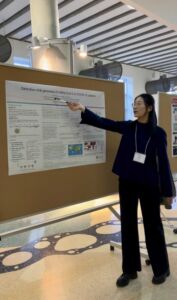 I’m usually at my desk or in the lab in the Discovery Building, focused on identifying and characterizing defective interfering particles (DIPs) in the human body.
These DIPs have fascinating potential: they could be harnessed to develop novel antiviral therapeutics that suppress viral replication by outcompeting normal viruses, coevolve with normal virus to resist virus escape, and even transmit between hosts via aerosol.
As a PhD candidate in biophysics working at the intersection of computational biology and virology, my typical day might include writing custom scripts to analyze sequencing datasets, refining computational pipelines to detect these elusive viral variants, culturing cells and virus, or collaborating with researchers from diverse fields to explore new experimental or modeling strategies. The Discovery Building’s collaborative and interdisciplinary environment makes it an ideal space for tackling complex problems, and it’s energizing to be part of such a dynamic scientific community.
What’s your favorite thing about this time of day?
Our lab thrives on interdisciplinary collaboration, and there’s always something buzzing—from setting up new experiments to brainstorming method improvements. It’s a space where biology, physics, and data science come together, and being part of that daily energy is what makes research here so rewarding.
 How can you tell if your work is going well?
In a field like mine, where both the biological systems and the data are complex, progress often comes in small but meaningful steps. I can tell my work is going well when I start seeing consistent patterns emerge from noisy datasets. It’s also encouraging when new code or pipelines I’ve developed are robust enough to be reused across different projects or shared with collaborators.
Another sign is when the work sparks good scientific conversations—whether it’s a PI getting curious about a figure I presented, or a collaborator suggesting a new angle based on my findings. These moments of engagement and curiosity from others are strong indicators that I’m asking the right questions and moving in a productive direction.
What tells you it’s not going as expected? What do you do when that happens?
I can usually tell things aren’t going as expected when results are inconsistent or when debugging takes longer than anticipated without clear progress.
When that happens, I try to take a step back to revisit the fundamentals. I also reach out to colleagues, especially those from different backgrounds, since a fresh perspective can often uncover something I’ve overlooked.