
4AM Bryce Sprecher
Where are you at this time and what are you most likely to be doing? (Or, What is going on in your lab at this particular time?)
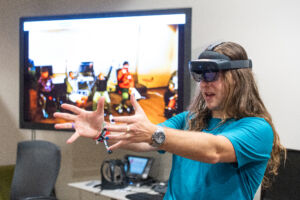
Bryce Sprecher demonstrating VR technology
This is a good time to start setting up our data processing for long photogrammetry renders of 3D models, such as visualizing a model of a shipwreck. For shipwrecks up in Lake Superior, they’re like 150 feet below the surface of the water and totally inaccessible. This is one way to show off hidden resources and archaeological and historical events. There is a lot of interest in using it for historical or cultural interpretation, whether something like a visitor center at a national park, or when we’re working at the Wisconsin Historical Society as part of a supplementary piece of media to go with a documentary. You can create a 3D model someone could interact with, a touch table where you could zoom in on interesting parts annotated with information from archeologists or historians. You could also make a 3D print of this—you could hold this model in your hand and get to look at all the intricacies. There’s a utilitarian part, too: mapping for shipping channels, for example. That can have a lot of value in safety, or certain habitats they are trying to maintain or reinforce.
When we’re using the software to build these 3D models, we’re starting with hundreds or thousands of 2D images, and the computer needs to go through a number of different processing steps to build the final 3D model that we can visualize either in a VR headset or in our 3D projected cave.
A couple thousand images, depending on the resolution, can take anywhere between 3 hours to 20 hours. So that’s why we like to start them at night. They will totally take all the resources that a computer has, so once you get that going, that computer is almost unusable.
Setting up the renders takes a couple hours, then you start the computer, all its fans whir on, and you can go home while it’s generating a bunch of heat and computations.
What’s your favorite thing about this moment in the lab?
It’s really gratifying when a 3D model pops out of all this processing. Because it’s such a multi-step thing, there’s always this sense of surprise and anticipation when you’re waiting for something to come out of it. When you come across things in the debris field, and you wonder what this thing is, and it can be very satisfying to identify a specific part of the ship, or teacups, or a piece of luggage. It’s a fun process, because you set up all this work to be automated while you’re away sleeping or doing other things and then you come back and it’s like unwrapping a Christmas present or something. Did it work? Does this look like something I recognize?
What tells you it’s not going as expected? What do you do when that happens?
Sometimes I’ve had these types of renders run, and on like hour 93 of the rendering process, it just dies. There’s no picking up from where you left off from those surprises: Windows updates, the computer restarted, we ran out of resources, or if you accidentally paused it to use the computer and forgot to turn it back on. You start over.