

12PM Josephine Putnam
Where are you at this time and what are you most likely to be doing?
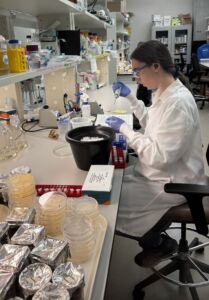
Josephine Putnam in the lab
At this time, I am most likely to be adding isopropanol to tubes of extracted DNA from soil bacteria. Next, I invert the tubes many times to mix them well and precipitate the DNA so that it becomes visible to the naked eye. Seeing threads of DNA become visible out of a clear solution will never cease to amaze me! Extracting DNA from soil bacterial isolates sent to our lab at the WID by college and high school Tiny Earth classrooms across the US is part of how we continue the antibiotic discovery pipeline that students begin in their classrooms. Tiny Earth (https://tinyearth.wisc.edu/), headquartered at the WID, is a global network of students and instructors who isolate bacteria from soil to search for new antibiotics. The DNA I extract is sequenced at the Joint Genome Institute and the resulting sequences are used to prioritize isolates for chemical analysis. In a bacterium’s DNA sequence, we can see biosynthetic gene clusters (BGCs) that encode for metabolites like antibiotics. By comparing these sequences to sequences that encode for previously discovered antibiotics, we can avoid re-discovery and prioritize isolates with BGCs encoding for possibly novel antibiotics for further testing.
What’s your favorite thing about this time of day?
My favorite thing about this time of day is getting into the “flow state” while I handle my samples. I love spending time at the lab bench!
Least favorite?
Sometimes, I perform DNA extractions on an extra-tricky batch of bacterial isolates, so very few of the DNA samples turn out to be of sufficient quantity and quality for sequencing. This can be frustrating after spending so many hours in the lab, but I do enjoy a challenge!
How can you tell if your work is going well?
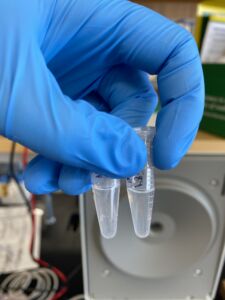 I can tell my work is going well if a large amount of DNA precipitates out of solution after mixing samples with isopropanol. This means that my DNA extraction was successful. I use several different methods to assess the quantity and quality of extracted DNA to determine if it meets the requirements for sequencing. I run my extracted DNA on an agarose gel to check if the DNA has been sheared into small pieces or not. I also use a Qubit fluorometer to quantify the amount of DNA in each sample and a NanoDrop spectrophotometer to assess the purity of my samples—whether they are contaminated with proteins or RNA.