

6AM Francesca Long
What are you often doing at that hour?
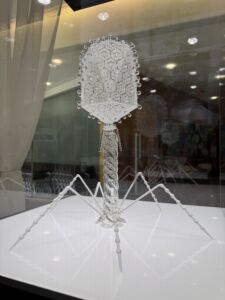
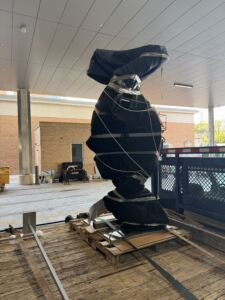 I am often on my way into the building or already there getting ready for a special event that helps connect the public with science happening at WID. When working in the John D. Wiley Gallery for Art in Science, I can be found adjusting the legs on the glass bacteriophage sculpture in case any have gone askew overnight, wiping down the display cases, choosing the colors for the pedestal lights, and generally making sure everything on display looks fresh for new eyes to take it all in. Sometimes I may be accepting a delivery of something exciting like an 800lb, 7ft sculpture!
What do you like most about this part of your day?
I like the peace and quiet of the building. Just the sounds of the water on the Fibonacci fountain next to the gallery, sometimes a bird fluttering by as it looks for a way back out onto the terrace, and the ability to move throughout the space without having to dodge students working quietly. I can bustle around without having to worry about who I might be disturbing and make it so that when folks do start coming in for an average day in the building or for a special event, the gallery looks ready and inviting.
What do you like least about this part of your day?
When it’s just me in the building, sometimes it’s not so fun forgetting something in one corner of a higher level and not being able to ask someone else to bring it for you! There can be a lot more running back and forth from our office on the 3rd floor to storage on the basement level and back up to the 1st floor again…
How can you tell when your work is going well?
I can tell when my work is going well when people stop and are curious about what we are doing. It’s great when someone who perhaps didn’t expect to have a science interaction that day pauses and opens themselves up to being inquisitive and wanting to know more. Being able to invite someone in to share in your enthusiasm and make them feel welcome to ask questions is a really great feeling, especially when it just happens naturally. A successful event allows for those natural moments of curiosity and usually ends with both me and the individual (or group) we are talking to learning something new!
How can you tell when it isn’t, and what do you do to address it?
 Sometimes people just aren’t as interested as you hope they will be and then it’s all about being flexible and adapting. Perhaps that means swapping out for a different activity, adjusting your engagement tactic from being more passive to more active (or the opposite depending on how comfortable folks are feeling that day!), and just going with the flow and knowing that not every single event will be a huge success. Setting your own metrics for success helps as well, these could be attendance numbers, quality of interactions, how long people stop and engage, etc. Being open to different ways of measuring success allows you to always find something positive to take away from an event while providing meaningful feedback on what could go better.