

Reshaping Memory with Artist-in-Residence, Viviane Silvera
Interdisciplinary artist Viviane Silvera illuminates the science of memory by turning it into an experience. For her Telly-Award-winning film See Memory, which is now streaming on PBS.org and will be screened at the Chazen April 18, the painter and filmmaker interviewed neuroscientists and painted more than 30,000 stills so that viewers could experience the scientific processes involved in the working of memory.
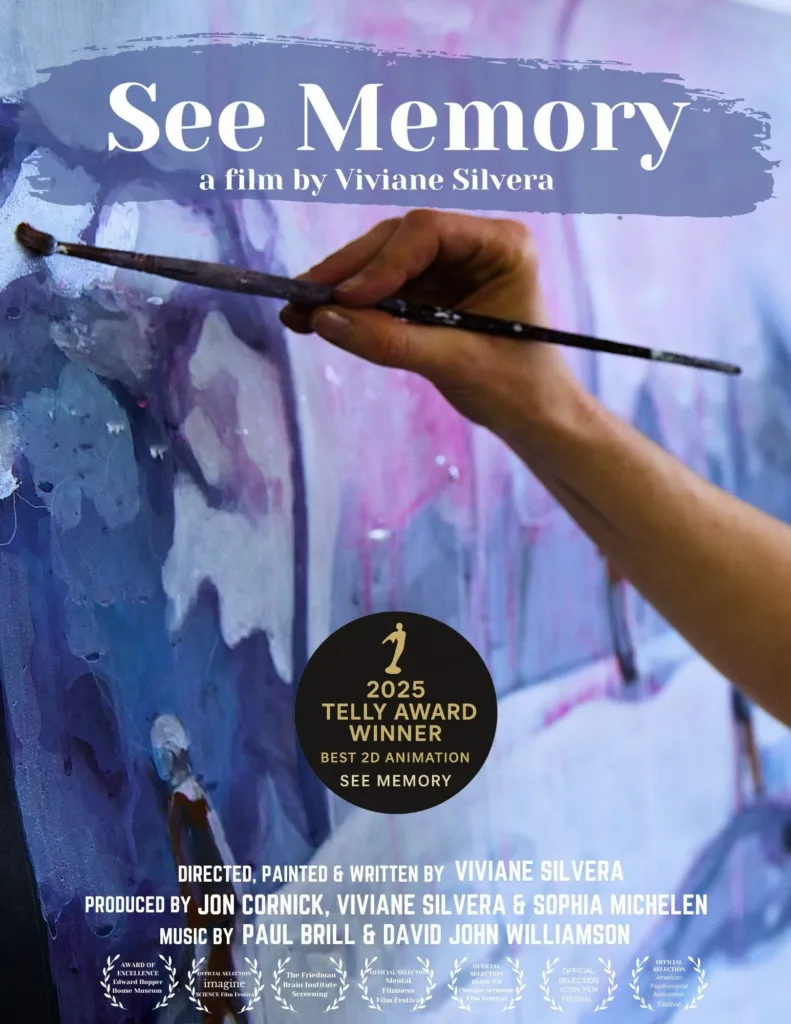
Silvera will be at UW-Madison April 13-24 as the Division of the Arts Spring 2026 Interdisciplinary Artist-in-Residence, in partnership with the Wisconsin Institute for Discovery (WID), for a packed slate of appearances, workshops, discussions and screenings, including Crossroads of Ideas (April 22) at WID and a discussion with writer Dale Kushner and
WID Writer-in-Residence Michelle Wildgen April 23 at 5 pm at the Chazen.
Silvera sees her work as a kind of translation, “taking something that exists as data or theory and turning it into something experiential… in See Memory, after many interviews with neuroscientists, I made a conscious decision to strip away terminology so the viewer could stay inside the experience rather than step outside of it to analyze.”
She first combined painting and film as a way to investigate her own recollections. “I had these gaps in my own memory—especially from my childhood in Hong Kong—and it felt less like something I could recall and more like something I could sense, almost like a dream I couldn’t fully access.”
Painting allowed her to get at the atmosphere of a memory, but extracting and painting stills from live-action footage achieved something more dreamlike and intuitive. Combined, the two allowed her to slow down and illuminate the invisible movement of memory itself. Science in turn provided “a way to understand the mechanics behind those processes, and in particular, how memory changes over time rather than simply being stored.”
While See Memory is Silvera’s creation, built through her long-term artistic practice and collaborations,
photojournalist Sophia Michelen supports aspects of Silvera’s engagements with scientists, clinicians,institutions, and audiences. The two share a common interest in how people engage with complex inner experiences.
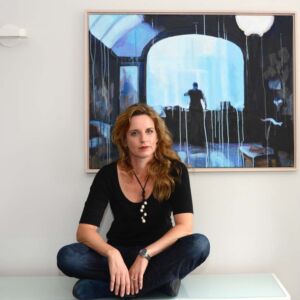
Viviane Silvera
“I’ve always been drawn to moments where something is happening just beneath the surface, where you can feel effort, tension, care, or history, even if it’s not explicitly stated,” says Michelen, who notes that a background in science trained her “to observe closely, to look for patterns, to understand systems.”
Silvera’s ongoing work continues to delve into memory, but is “expanding from individual memory into more collective and inherited forms of memory.” Her current work in progress, The Memory Loophole, follows a daughter trying to reconstruct her father through fragments and explores “how memory operates across generations.”
“And what I keep returning to is that memory isn’t fixed,” Silvera says, “and that instability can be disorienting as much as it is generative. It changes how you think about identity, healing, and storytelling, without necessarily settling those questions.”
Learn more about Silvera’s fascinating, evocative work at one of her talks, screenings, and workshops, now through April 23.
Related Posts
widiscoveryuw Instagram