
Building Community Through Indigenous Languages
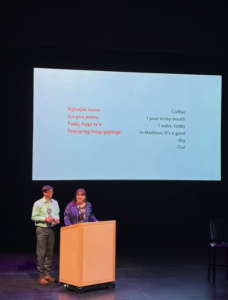
Chloris Lowe and Laura Red Eagle, Photo Credit, Carla Vigue
In April, members of the Indigenous Language Table stood before a sold out audience gathered at the Playhouse Theater in Madison, WI, to hear former U.S. Poet Laureate Joy Harjo speak about the importance of place. Instead of a land acknowledgement, participants shared original poems they had written in Ho-Chunk about Teejop (Ho-Chunk for “Madison,” meaning “four lakes”), a city the Ho-Chunk have called home for more than ten thousand years. No English was spoken during the presentation. Instead, translations appeared on a screen behind the speakers, allowing the audience to experience the language as it was heard for thousands of years.
Mąįtajewehi hop̨in̨i (swirling wind)
Mąąšją hojikere (brings strength here)
Hižąkixjį mąą̌ (a land/place that draws you)
~Caaxšepsgaa
This moment reflects what the Indigenous Language Table has been working toward for four years, creating a space where Indigenous languages are not simply learned, but actively used, shared, and celebrated.
Now entering it’s 5th year, and founded through the Wisconsin Institute for Discovery in partnership with ENWEJIG Indigenous Language Advocates and the Illuminating Discovery Hub, the Indigenous Language Table was created to support language learners beyond the classroom. While the University of Wisconsin–Madison has offered Indigenous language courses for many years, opportunities to practice those languages in informal community settings did not exist. The program was designed to help fill that gap by providing a space where learners and speakers can gather regularly to build confidence, strengthen connections, and normalize the use of Indigenous languages in everyday life.
Indigenous languages are endangered. Founder Laura RedEagle, and former language apprentice estimates that there are fewer than 20 first-language Ho-Chunk speakers remaining. Creating a space where speakers and learners at all levels can connect, practice and learn from one another is an important part of supporting language preservation and revitalization.
An Indigenous Language Table is not a language class. Rather, it is a community gathering where participants practice speaking, listening and strengthening their relationship with indigenous language through conversation, story telling, and games. The gatherings cover everyday conversation, including discussion about how to translate modern words like “electric scooter” or “wi-fi” and modern concepts such as taxes. Participants also create games, listen to recordings, and decipher old writing. Because the table includes undergraduate students, graduate students, faculty, staff, and members of the broader community, connections happen here that might not otherwise occur.
“One thing I really appreciate about Language Table is that it makes learning feel possible without making it feel easy in a shallow way. I have learned through repetition, adapted games, listening to others practice and explain word usage, and trying to understand how to express things from within a different worldview. I have also been moved by seeing how much care people bring to even a single word!” – Shiqi, UW–Madison Graduate Student
In addition, the program has welcomed a variety of guests and experiences that have enriched those conversations. Participants met with Indigenous youth visiting from Montana to discuss how indigenous language can be used to describe archaeology while keeping cultural heritage context. Two Elder-in-Residence visits allowed the group to learn directly from respected knowledge keepers. Photojournalist Sophia Michelen joined the group to share her work and engage participants in conversations about storytelling, identity, and representation. The program was also featured in Midwest Arts magazine, which highlighted the table’s role in bringing Indigenous languages into public spaces and everyday life.
The Language Table has also become an ongoing experiment in language immersion. Participants engage not only with their own language-learning journeys, but alongside learners and speakers of multiple Indigenous languages, creating opportunities to share experiences and find commonality across communities. Languages represented through the program and UW–Madison’s Indigenous language offerings include Ho-Chunk, Menominee, Oneida, Dakota, and Ojibwe.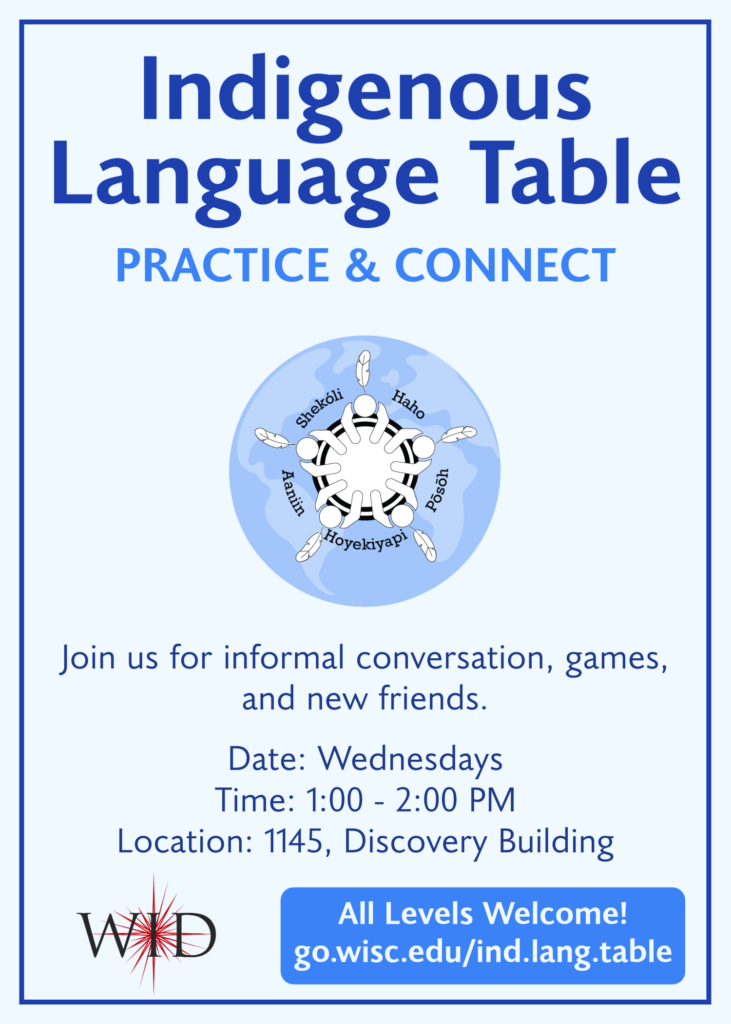
In essence, the Indigenous Language Table reflects the Wisconsin Institute for Discovery’s commitment to Indigenous linguistic justice and language revitalization. Language revitalization efforts often struggle because there are few places where learners can regularly gather to practice and build a sustaining community. Indigenous languages must exist in living, contemporary spaces, outside of classrooms, in order to be normalized. The work that happens around the table is also a reminder that Indigenous people are not defined solely by history, but are living, thriving communities whose languages continue to evolve and be spoken today. Looking ahead, organizers hope to incorporate virtual participation options, allowing learners and speakers to connect through Zoom and other online platforms. Expanding access could make it easier for people across Wisconsin and beyond to participate in conversations that support language learning and community building.
Like many grassroots language efforts, the program has faced challenges: too-few speakers, overextended language leaders, and inadequate resources can all hinder language revitalization. Maintaining opportunities for conversation requires persistence, creativity, and a strong commitment from participants.
Despite those challenges, it has sustained its momentum and continues to show promise. The Ho-Chunk poetry at the Joy Harjo event was a powerful example of Indigenous language speakers moving beyond learning language to creating with it, expressing their connection to place through original poetry and sharing those words with a public audience.
The success of the Indigenous Language Table demonstrates that language revitalization is about more than preserving words. It is about creating spaces where communities can gather and languages can live.”
“Though I’m a longtime linguist and language enthusiast, UW-Madison’s Indigenous Language table has revolutionized my understanding of what language reclamation really is: language community. This means meeting every single person exactly where they are, with arms wide open as we share friendship, encouragement, real-life conversation practice and language learning strategies.” Síle Shigley, Producer and Host for “Simply Folk” on WPR
Written by Laura RedEagle
Founder, Indigenous Language Table and Communications Manager, Wisconsin Institute for Discovery
Related Posts
widiscoveryuw Instagram