
Stories
App under development at UW could make it easier, more affordable to ‘age in place’
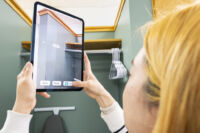
Researchers are using augmented reality to help make homes safer for older adults through a tool called ARHAT—the Augmented Reality Home Assessment Tool. ARHAT guides users through a process to measure key features of a living space and suggests accessibility improvements. By streamlining what can be a clunky and expensive process, the tool supports a more affordable, community-based approach to home safety. The project is led by Jung-hye Shin and Kevin Ponto from the Department of Design Studies and the Wisconsin Institute for Discovery, alongside occupational therapist and kinesiology professor Beth Fields.

New advanced optimization course provides industry preparation
WID Discovery Fellow, Jim Luedtke created a course to build on students’ basic knowledge of optimization, teach them to apply more advanced modeling techniques and introduce them to real-world considerations like prioritizing computational efficiency. This course bridges the gap between introductory topics and real world applications.
Science is Global: Building Bridges with Dr. Kris Saha
Speaking to the Global Health Institute at UW–Madison, Saha notes, "Both locally and abroad, my sense is there are unknown questions we’re asking, and there’s a mutual interest in being able to solve them for advancing healthcare. The role of a public university is to try to answer those questions for public benefit and, yes, to help make a company that can produce it in a sustainable and safe way – to get that impact and employ people in the process."
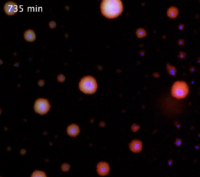
Co-Zorbing: The New Frontier in Bacterial Cooperation
In a recent study published in Proceedings of the National Academy of Sciences (PNAS), researchers discovered that biofilms made of a specific type of bacterium, Flavobacterium johnsoniae, can form 3-D structures called Zorbs that are capable of moving. Not only do these structures move, but researcher, Shruthi Magesh, from the Wisconsin Institute for Discovery have also found that they can transport other species of bacteria by forming tri-zorbs.
Announcements
24 Hours with WID
 The Wisconsin Institute for Discovery is abuzz 24 hours per day. From “eureka” moments in the middle of the night to methodical pipetting in the middle of the day, to gathering diverse ideas from across the globe in the early evening, something is always happening in our interdisciplinary sphere. Enjoy a sampling of the important work we do in each of these 24 hours and please come back periodically as we refresh with new profiles.
Follow Us
Learn more about the Wisconsin Institute for Discovery through quarterly newsletters and receive our annual report.