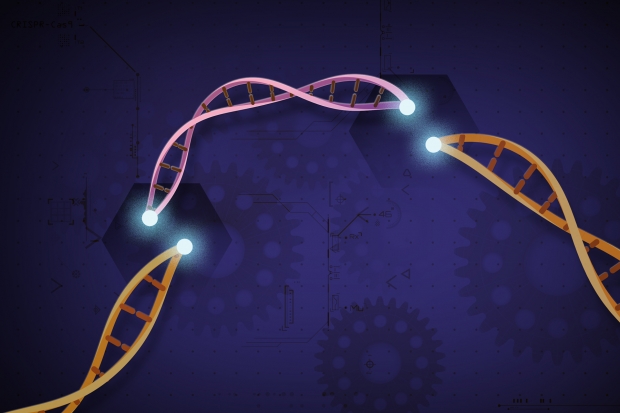

The advent of the CRISPR-CAS9 technique gives researchers the ability to make precise changes to the DNA of, theoretically, any living organism that has DNA. That precision is particularly meaningful for treatment of diseases caused by well-known faults in genes — otherwise incurable diseases such as sickle cell anemia, the fatal lung disorder cystic fibrosis, and the blindness-causing Leber congenital amaurosis. CRISPR-Cas9 could be a way to prevent or reverse those disorders.
CRISPR with a ‘dimmer’ could elevate precision gene editing
ppointer2025-11-11T11:23:18-06:00“This platform has the potential to ‘dim’ genome editing in a wide variety of contexts,” says WID faculty, Krishanu Saha, “not only inside the body, but outside the body, and also has implications for fundamental studies of how genome editing occurs in cells, in tissues, and in animals.”