
Calendar of Events
S Sun
M Mon
T Tue
W Wed
T Thu
F Fri
S Sat
2 events,
Sci-prov
Sci-prov
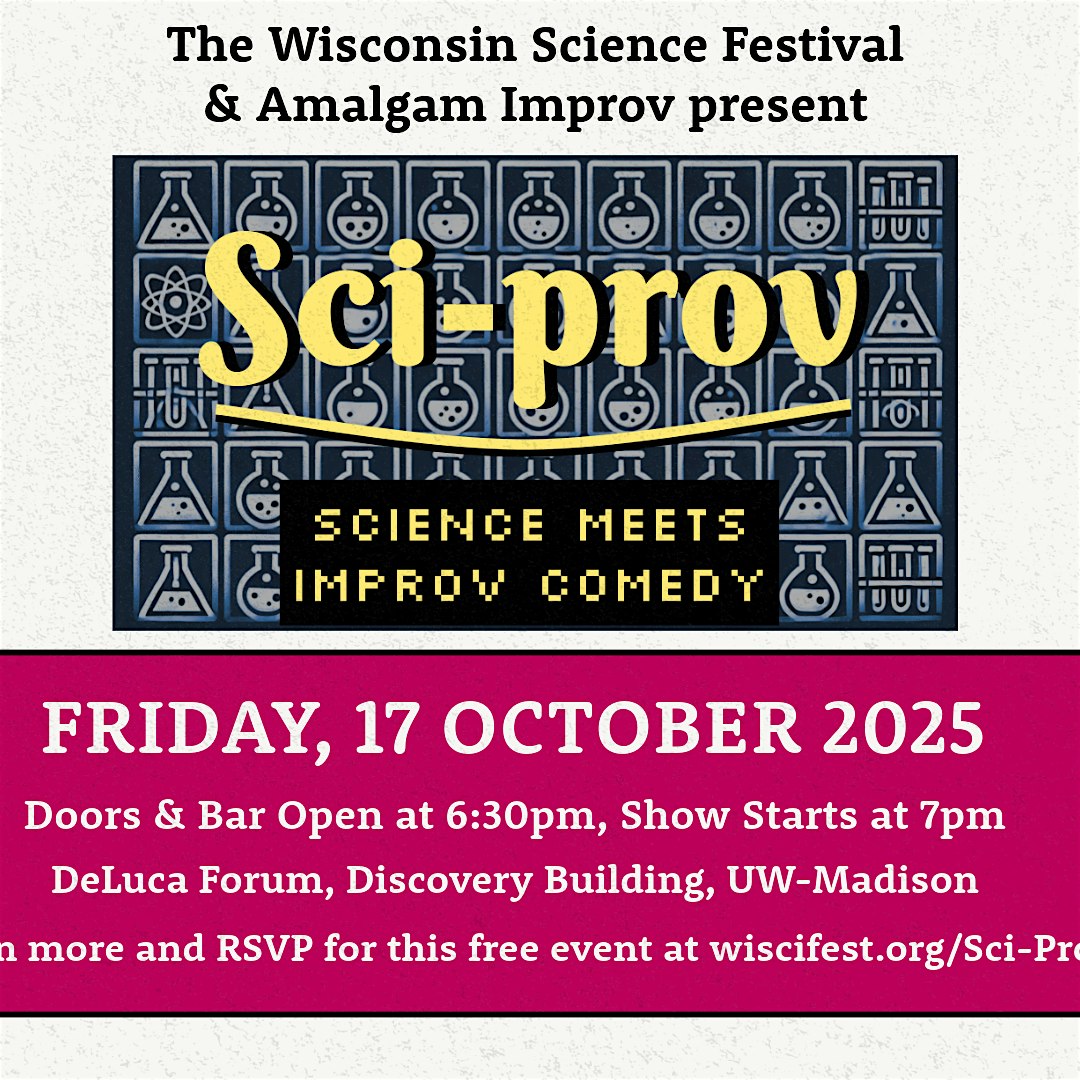
Science Meets Improv Comedy in this special Wisconsin Science Festival edition! Presented in partnership with Amalgam Improv.Join the Wisconsin Science Festival and Amalgam Improv for an evening fusing science and spontaneous improv comedy like no other at Sci-prov!Sci-prov combines science and improv in creative, funny, and never before seen ways. In this special, fusion event, scientists Rachael Shields and Amy Koike will present their work in short, digestible presentations followed by brief Q&A, all of which will become fodder for the improv scenes. The improv scenes are created on the fly, unique to each show, and performed by a troupe of [...]
5 events,
COMBINE 2025
Computational Modeling in Biology (COMBINE) 2025 will be a workshop-style event hosted by the University of Wisconsin- Madison, USA.
COMBINE 2025
COMBINE 2025
Computational Modeling in Biology (COMBINE) 2025 will be a workshop-style event hosted by the University of Wisconsin- Madison, USA.Welcome to the the 16th International meeting of the "Computational Modeling in Biology" Network (COMBINE) will take place as an in person meeting in Madison, Wisconsin, United States of America from October 20-23, 2025.Registration is open until September 28, 2025 for in person attendance. $199 USD for in person attendees.The fee will increase after September 28th is slots are still available.REMEMBER, AFTER YOU FILL OUT THE REGISTRATION HERE: GO BACK TO THE REGISTRATION GOOGLE FORM TO FINISH YOUR REGISTRATION WITH YOUR TICKET NUMBER. [...]
Finding Your Place in Science: Writing Workshop to Explore Scientific Identity
Finding Your Place in Science: Writing Workshop to Explore Scientific Identity
Part of the Wisconsin Science Festival, hosted by WID. Michelle Wildgen—editor, teacher, and author—will lead a Wisconsin Science Festival writing workshop on scientific identity. Aimed at students but open to all, the session explores what it means to “belong in science.” Through discussion and writing, participants will examine assumptions about who fits in STEM, broaden ideas of identity, and reflect on how belonging (or not) shapes persistence in science. Registration required, limited space. CONTACT: 316-4325, lredeagle@wisc.edu URL: https://www.eventbrite.com/e/finding-your-place-in-science-tickets-1641129435319?aff=oddtdtcreator
Finding Your Place in Science
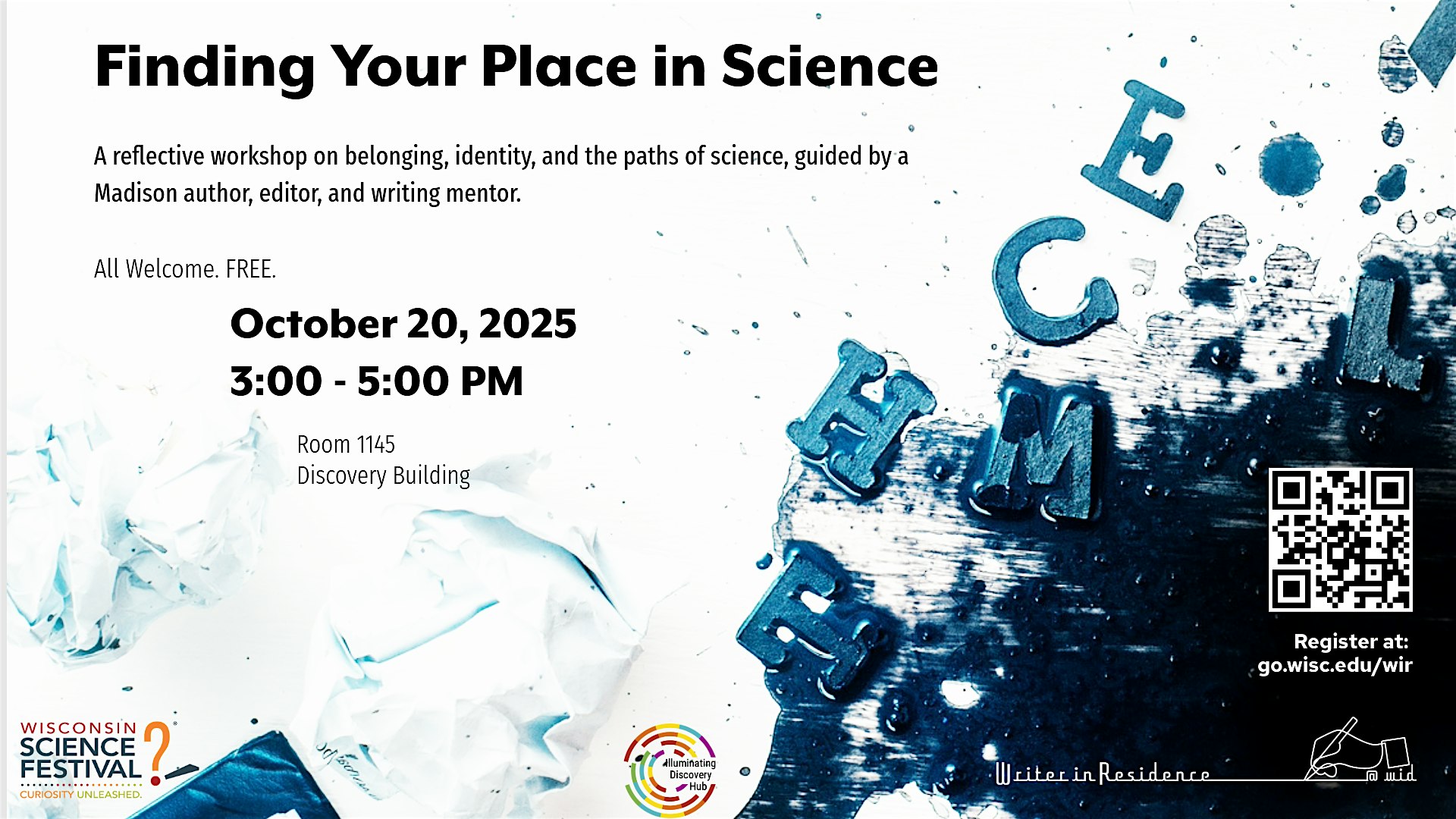
Finding Your Place in Science
A reflective workshop on belonging, identity, and the paths of science, guided by Madison author, editor, and writing mentor. All Welcome.Finding Your Place in Science: A Writing Workshop to Explore Scientific IdentityOct. 20, 3 pm, Location: 1145 Discovery BuildingLight snacks providedMichelle Wildgen is an editor, teacher, and writer of literary fiction and essays, as well as the author of four novels and cofounder of the Madison Writers’ Studio.A scientific identity – essentially, whether a person feels they belong in the world of science —is associated with longevity and success in STEM-related fields. But what does it mean to belong in science? [...]
4 events,
COMBINE 2025
Computational Modeling in Biology (COMBINE) 2025 will be a workshop-style event hosted by the University of Wisconsin- Madison, USA.
The WhySci Variety Show
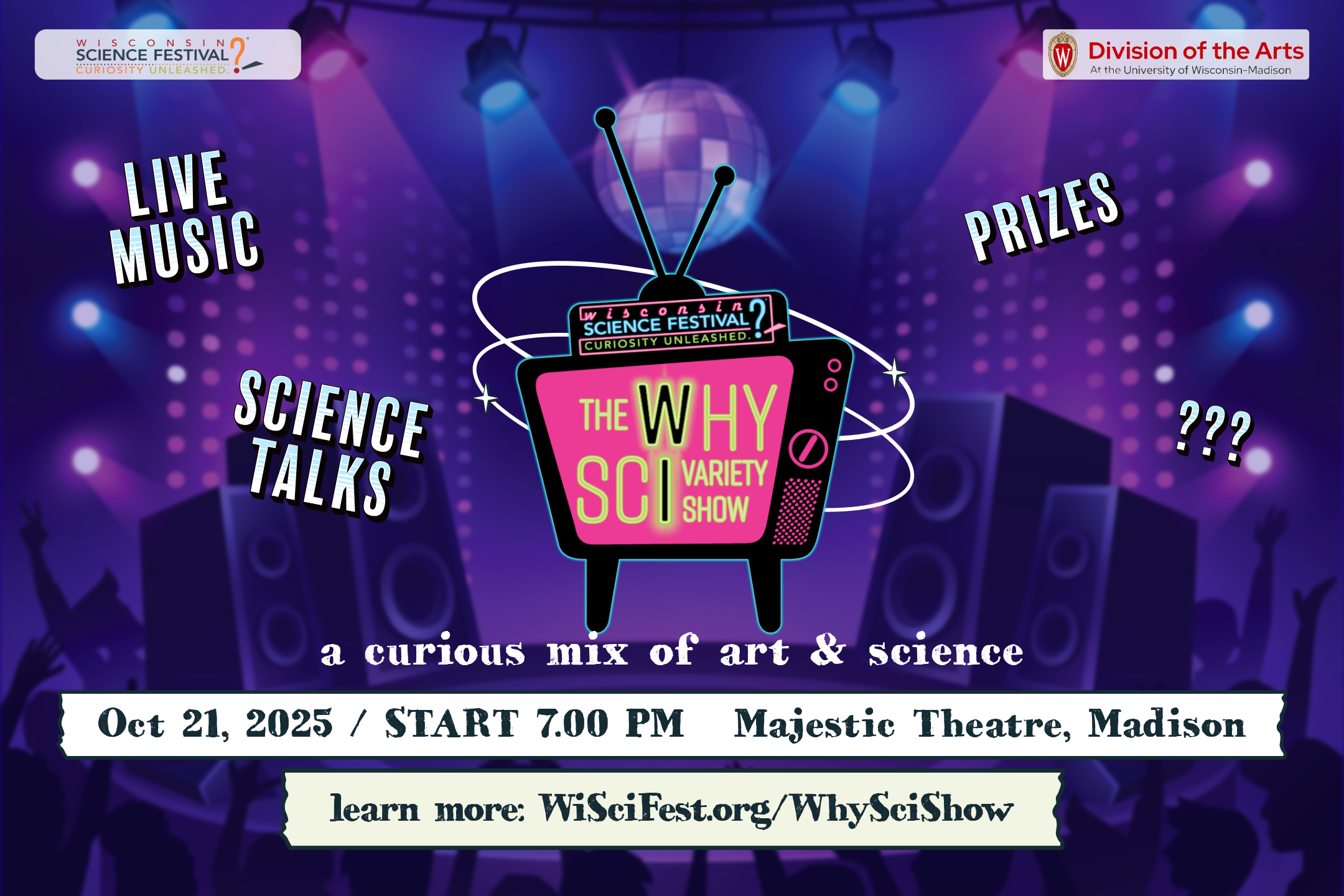
The WhySci Variety Show
The most science-inspired variety show in town! Produced by the Wisconsin Science Festival and the UW-Madison Division of the Arts. Get ready to rock your curiosity at the Why Sci Variety Show—a high-energy mashup of science talks, artful performances, and live music! This year’s theme is Rock and Roll, so expect brainy beats, geology jokes, and scientific showmanship that will have you thinking and tapping your toes. Hosted by the always-entertaining Ben Rush and featuring tunes from our live house band: David Hecht & The Who Dat, this is edu-tainment at its finest. From ancient rocks to musical molecules, science and [...]
6 events,
COMBINE 2025
Computational Modeling in Biology (COMBINE) 2025 will be a workshop-style event hosted by the University of Wisconsin- Madison, USA.
Intro to Docker/Podman
Intro to Docker/Podman
Learn Skills for Research Software Engineering. This session aims to introduce the use of Docker containers with the goal of using them to effect reproducible computational environments. Such environments are useful for ensuring reproducible research outputs. CONTACT: facilitator@datascience.wisc.edu URL: https://uw-madison-datascience.github.io/2025-10-01-uwmadison-mini/
Indigenous Language Table
Indigenous Language Table
A safe place to practice indigneous languages. An Indigenous Language Table supports learners in developing spoken skills beyond the classroom, building community, strengthening purpose, and normalizing Indigenous languages through representation. It welcomes former students and ongoing learners, community members from classes or self study, and anyone interested in Indigenous languages and people. CONTACT: 316-4325, lredeagle@wisc.edu URL: https://illuminatingdiscovery.wisc.edu/indigenous-language-table/
Crossroads of Ideas: Threading the Story of Earth’s Oldest Rocks
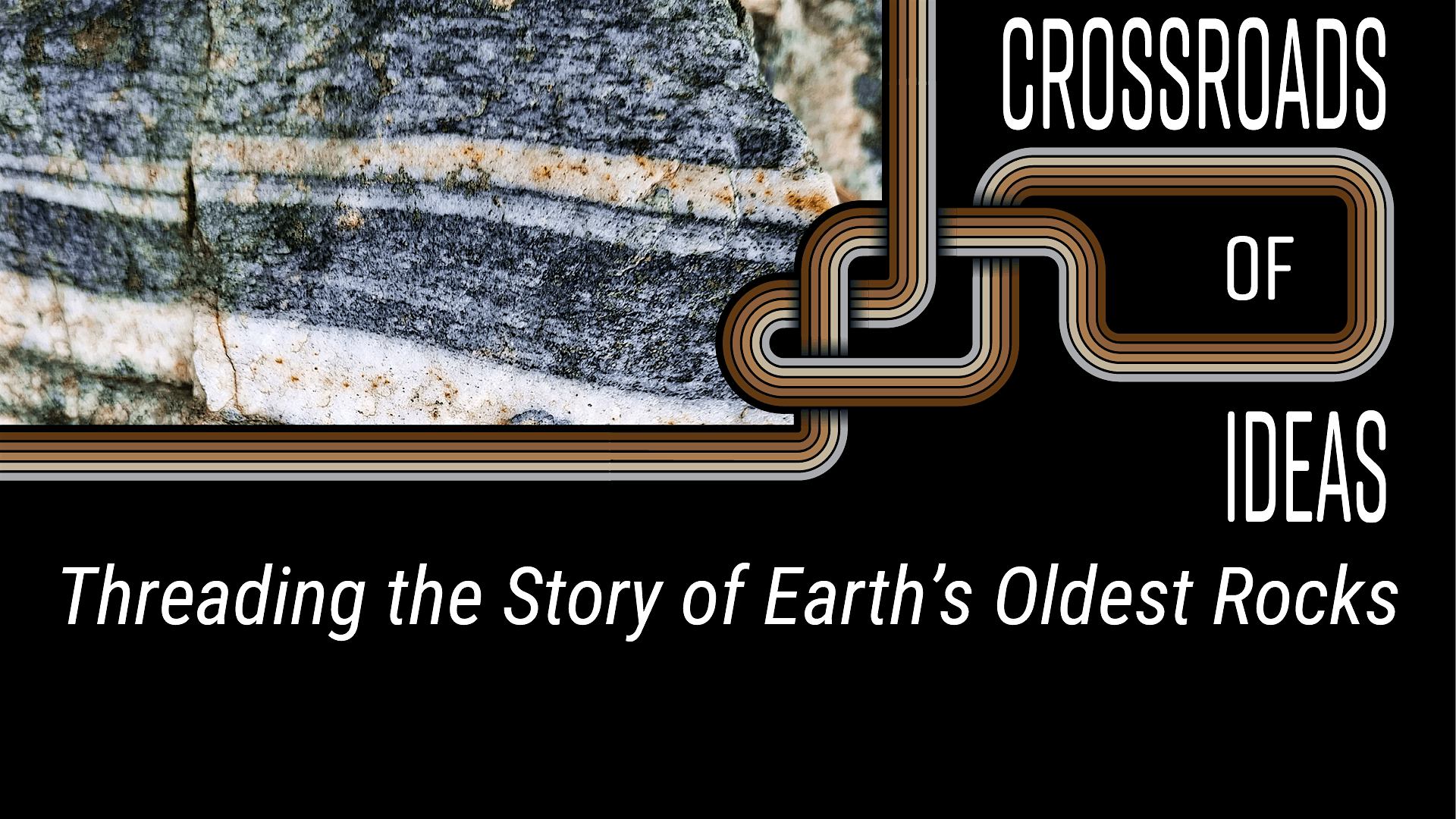
Crossroads of Ideas: Threading the Story of Earth’s Oldest Rocks
Ancient geology meets modern creativity! Scientists studying the Earth’s oldest rocks collab with a textile artist to bring them to life!Join us for a very special Wisconsin Science Festival edition of Crossroads of Ideas, where ancient geology meets modern creativity. This engaging evening features scientists Tyler Blum, Annie Bauer, and Emily Mixon, who have been studying the Earth’s oldest rocks - Acasta Gneiss (that’s pronounced “nice”) - and collaborating with local textile artist, Leah Evans, to bring 4-billion-year-old stories to life.In conversation with UW-Madison Geology Museum Associate Director, Brooke Norsted, learn how these researchers and artist have explored deep time, planetary [...]
5 events,
COMBINE 2025
Computational Modeling in Biology (COMBINE) 2025 will be a workshop-style event hosted by the University of Wisconsin- Madison, USA.
Intro to Docker/Podman
Intro to Docker/Podman
Learn Skills for Research Software Engineering. This session aims to introduce the use of Docker containers with the goal of using them to effect reproducible computational environments. Such environments are useful for ensuring reproducible research outputs. CONTACT: facilitator@datascience.wisc.edu URL: https://uw-madison-datascience.github.io/2025-10-01-uwmadison-mini/
Michelle Thaller: Cosmic Treasures
Michelle Thaller: Cosmic Treasures
Chasing Asteroids for Clues to the Origins of LifeJoin Michelle Thaller, former NASA science communicator, for an evening exploring the origins of life. Thaller, in conversation with Eric Wilcots, Dean of the College of Letters & Sciences and Professor in the Dept of Astronomy, will talk about the OSIRIS-REx mission – an audacious project to return a sample from an asteroid. No problem, right? Just chase down a small rock 200 million miles away, traveling literally faster than a speeding bullet, vacuum up a sample of its surface, and shoot it back to Earth. The story turned out to be more [...]
4 events,
WID Seminar Series
WID Seminar Series
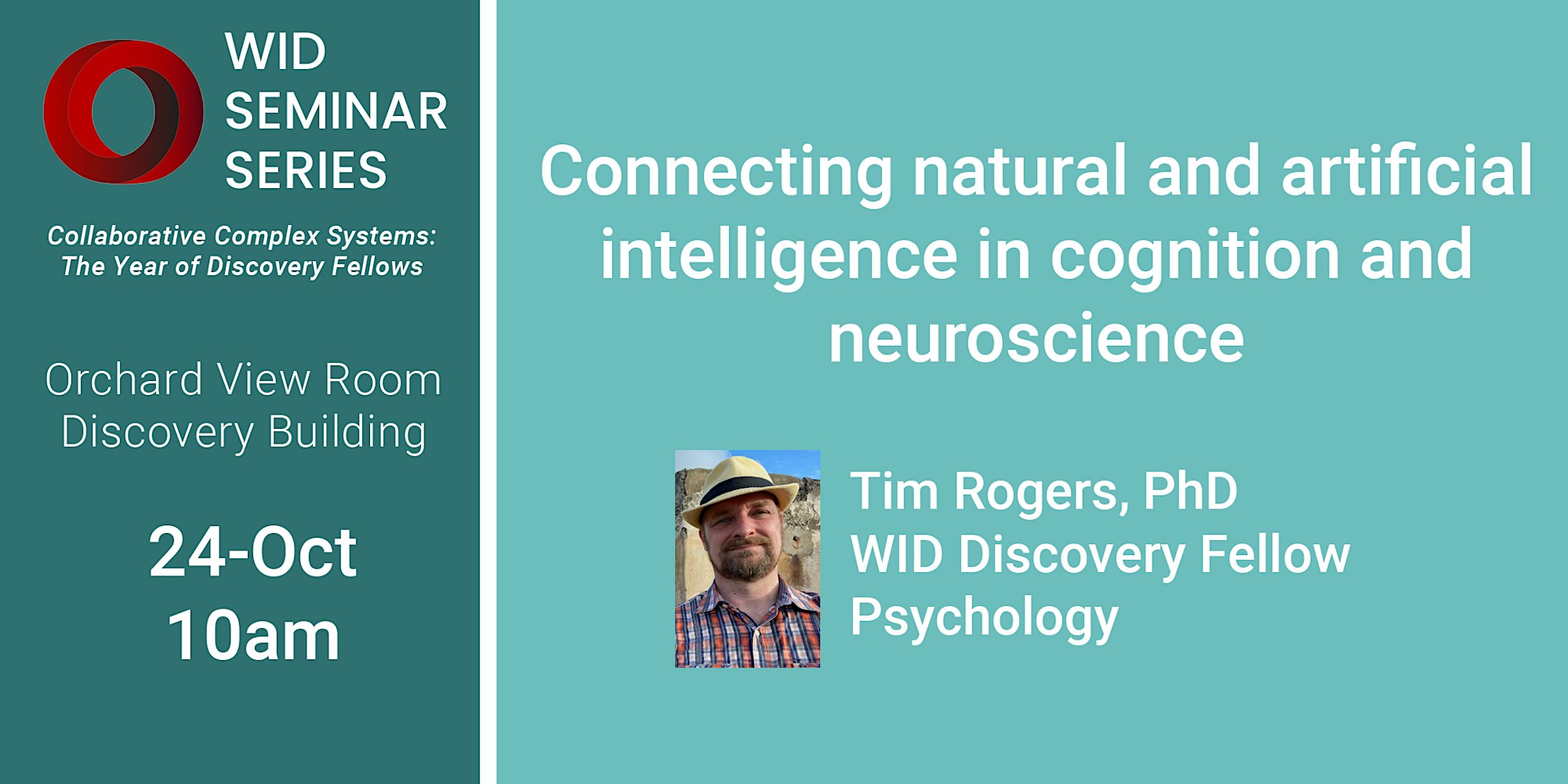
Connecting natural and artificial intelligence in cognition and neuroscienceCollaborative Complex Systems: The Year of Discovery FellowsRob Nowak, WID Discovery Fellow and professor of Electrical and Computer Engineering introduces Tim Rogers, WID Discovery Fellow, professor of Psychology.
WID Seminar Series: Tim Rogers
WID Seminar Series: Tim Rogers
Connecting Natural and Artificial Intelligence in Cognition and Neuroscience. WID Seminar Series: Collaborative Complex Systems: The Year of Discovery Fellows Connecting Natural and Artificial Intelligence in Cognition and Neuroscience Tim Rogers WID Discovery Fellow Psychology With introduction by Rob Nowak, WID Faculty, Electrical & Computer Engineering CONTACT: 316-4325, lredeagle@wisc.edu URL: https://wid.wisc.edu/ ONLINE: https://uwmadison.zoom.us/j/98293855424
2 events,
SoundWaves: Atomic Scale
SoundWaves: Atomic Scale
This academic year, SoundWaves is exploring scales. Join us for this first edition diving into the atomic scale - and Klezmer scales!Gaze into the world of the unimaginably small with an evening exploring the atomic scale. What is quantum computing and how does it work? How do atoms in metals organize themselves into hierarchies? As part of Klez Fest Midwest, this special SoundWaves event will feature more live music than ever, with the duo of Krakauer & Tagg, featuring brilliant klezmer clarinetist David Krakauer and pianist Kathleen Tagg, performing and explaining what gives klezmer music its characteristic style and sound (it’s [...]